

If you ask ten people how to get into exports, nine of them will start talking about factories. Machines, workers, raw material, a production line running twelve hours a day. That’s the picture most people have in their head, and honestly, it’s the reason most people never start.
Here’s the thing nobody tells you upfront: you don’t need to make anything to export it. You just need to know how to move a product from a manufacturer’s floor to a buyer’s warehouse on the other side of the world, and get paid properly for making that happen.
This is called being a merchant exporter, and it’s one of the most underused paths into international trade, especially for people in countries like Pakistan where we have incredible manufacturing capability sitting in small and mid-sized factories that have zero idea how to reach a buyer in Germany or Texas.
I work in this space, mainly around surgical instruments and a few other export categories, and I can tell you the model works. Not overnight, and not without effort, but it works without you ever touching a lathe machine or hiring a production manager.
Let’s break down exactly how it’s done.
What a Merchant Exporter Actually Does
A merchant exporter buys finished goods from a manufacturer and sells them abroad under their own business name. You’re not the factory. You’re the bridge between the factory and the buyer.
You handle the sourcing, the quality checks, the pricing, the paperwork, the buyer relationship, and the logistics. The factory handles production. That’s the whole split.
This is different from being a commission agent who just introduces two parties and steps back. As a merchant exporter, you own the transaction. You buy the goods, you take the risk of the deal, and you keep the margin. That ownership is what makes this a real business and not a side hustle referral game.
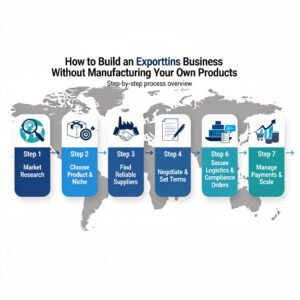
Step 1: Pick a Product Category You Can Actually Learn
This is where most people mess up. They chase whatever looks trendy without checking if there’s real, boring, repeatable demand behind it.
A few things I’d actually check before locking a category:
Does your country already have manufacturing strength here? Pakistan is strong in surgical and dental instruments, leather goods, textiles, sports goods, and increasingly in natural and wellness products. Working with an existing manufacturing base means you’re not trying to convince factories to make something unfamiliar. They already know how to produce it, you just need to learn how to sell it.
Can you get samples and specs without a huge upfront spend? Some categories need certifications, lab testing, or heavy compliance work before you can even show a sample to a buyer. Others, you can literally get a sample box couriered to you within a week. Start with the second kind.
Is the buyer base large enough that you’re not fighting for one client? A niche is good. A niche with three possible buyers on the entire planet is not.
I’d genuinely tell anyone starting out to pick one product, not a catalogue of fifty things. Get good at selling one category first. You can expand later once you understand how buyers in that space think, what specs they ask for, and what actually closes deals.

Step 2: Find Your Manufacturing Partners
Once you know your product, you need suppliers you can actually trust, because your entire reputation with the buyer rests on their production quality, not just your sales pitch.
Here’s how I’d approach it practically:
- Visit local trade bodies and chambers of commerce. Every export-heavy city has an association tied to its main industries, and they usually maintain lists of registered manufacturers.
- Go to the actual manufacturing clusters if you can. Nothing replaces walking a factory floor and seeing how they handle order sizes, deadlines, and quality control.
- Ask for previous export samples, not just domestic ones. Export-grade finishing is often a different standard than what’s sold locally.
- Build relationships with two or three manufacturers per product, not just one. If one gets overbooked or has a bad quarter, you need a backup that can step in without your buyer noticing anything changed.
Don’t rush this step. A weak supplier relationship is the single fastest way to lose a buyer you worked months to land.
Step 3: Get Your Paperwork and Registrations Sorted
This part sounds boring but it’s non-negotiable, and skipping it or doing it half properly is where a lot of small exporters get stuck later.
Depending on your country, you’ll typically need:
- Business registration (in Pakistan this usually means SECP or a sole proprietorship setup with FBR, plus your NTN)
- An export license or code (WeBOC and PSW registration in Pakistan, IEC if you’re in India, EIN-linked export registration in the US, and so on)
- Membership with your relevant chamber of commerce, since many buyers and even banks want to see that
- Any product-specific certifications your category demands, for example CE marking or ISO standards for surgical instruments, or organic and quality certifications for natural products
I know this feels like admin work that has nothing to do with actually selling. But buyers, especially serious B2B buyers, will ask for this before they wire any real money. Having it ready before you start pitching saves you from losing a deal at the finish line because you were still filling forms while the buyer moved to a competitor.
Step 4: Set Your Pricing and Terms Properly
New exporters almost always underprice themselves in year one. It happens because they’re excited to land any deal, so they quote low and hope volume makes up for thin margins.
Your price needs to cover:
- What you’re paying the manufacturer
- Packaging and labeling costs
- Freight and insurance (depending on whether you’re quoting FOB, CIF, or another Incoterm)
- Your margin, which needs to actually be worth your time
- A buffer for currency fluctuation if you’re invoicing in a foreign currency
Learn Incoterms properly before your first shipment. FOB, CIF, EXW, these aren’t just abbreviations, they decide who’s responsible for what cost and risk at every point of the journey. Getting this wrong on your first few deals can quietly eat your entire profit.
Also, decide your payment terms before the buyer decides them for you. Letter of Credit, advance payment, or partial advance with balance on shipment, each has different risk levels. Don’t ship a full container on trust alone with a first-time buyer.
Step 5: Find Buyers, the Real Work Begins Here
This is the step people struggle with the most, because it’s not a one-time task, it’s an ongoing discipline.
A few channels that genuinely work:
B2B marketplaces. Platforms where international buyers actively search for suppliers are still one of the fastest ways to get inbound inquiries, especially when you’re new and don’t have a network yet. Keep your listings detailed, with real photos, clear specs, and honest minimum order quantities.
Trade portals run by export promotion bodies. TDAP in Pakistan and similar bodies elsewhere maintain buyer-seller matchmaking programs, trade delegations, and country-specific market reports. These aren’t flashy, but they connect you with buyers who are already vetted to some degree.
LinkedIn, done properly. Not spam-adding people. Actually searching for procurement managers, sourcing heads, and import business owners in your target country, and engaging with what they post before you ever pitch anything.
Trade fairs, physical and virtual. Nothing replaces a face to face conversation for building trust with an international buyer, but virtual trade fairs and sourcing events have become a solid, cheaper alternative if you can’t travel yet.
Cold outreach through email and WhatsApp Business. Old school, still works if your message is specific to the buyer’s business rather than a generic copy-paste pitch.
Google and industry directories. Search for importers of your specific product in your target country. Import-export data platforms can show you who’s already importing similar goods, which tells you demand is real and gives you a warm list to approach.
The pattern I’d tell anyone to follow: stack multiple channels instead of betting on one. Buyers respond to different things. Some want you cold emailing them, some only trust what they find on a marketplace, some need to shake your hand at an expo first.
Step 6: Handle the Deal from Sample to Shipment
Once a buyer shows real interest, the process usually goes something like this:
- Send samples, sometimes free for small samples, sometimes paid for larger ones
- Negotiate pricing, quantity, and payment terms
- Sign a proforma invoice or agreement
- Place the order with your manufacturer and monitor production closely
- Arrange quality inspection before shipment, either yourself or through a third-party inspection service the buyer trusts
- Coordinate with a freight forwarder for shipping, customs clearance, and documentation
- Ship the goods and send shipping documents to the buyer
- Follow up after delivery, because a happy buyer is a repeat buyer
Freight forwarders are worth their fee in year one especially. They know the customs process, the paperwork, and the shipping lines far better than you will starting out, and a mistake in shipping documents can delay a container at port for weeks.
Mistakes I See Beginners Make Again and Again
Chasing every product category at once. Trying to sell five unrelated products before mastering one just spreads your credibility thin with buyers and manufacturers both.
Skipping quality inspection to save a small fee. One bad shipment can end a buyer relationship permanently, and word travels fast in tight-knit import communities.
Underestimating how long the sales cycle takes. International B2B deals rarely close in a week. Some buyers take months of relationship building before they place a first small trial order.
Not having backup suppliers. Relying on one factory for one product line is fragile. If they miss a deadline, you’re the one explaining it to an angry buyer.
Ignoring after-sales communication. Exporters often go quiet after shipment. Buyers remember who followed up and who disappeared once payment cleared.
Final Thoughts
The barrier to starting an export business was never really about owning a factory. It’s about learning how to source reliably, price correctly, find buyers who actually need what you’re offering, and manage the paperwork that ties it all together.
None of that requires machinery. It requires patience, attention to detail, and a willingness to learn the boring compliance side alongside the exciting deal-making side.
If you’re sitting on the sidelines because you think manufacturing is the entry ticket, it isn’t. Start with one product, find one reliable manufacturer, learn your documentation, and go find your first buyer. Everything after that first successful shipment gets easier, because now you have proof, references, and a process you can repeat.
